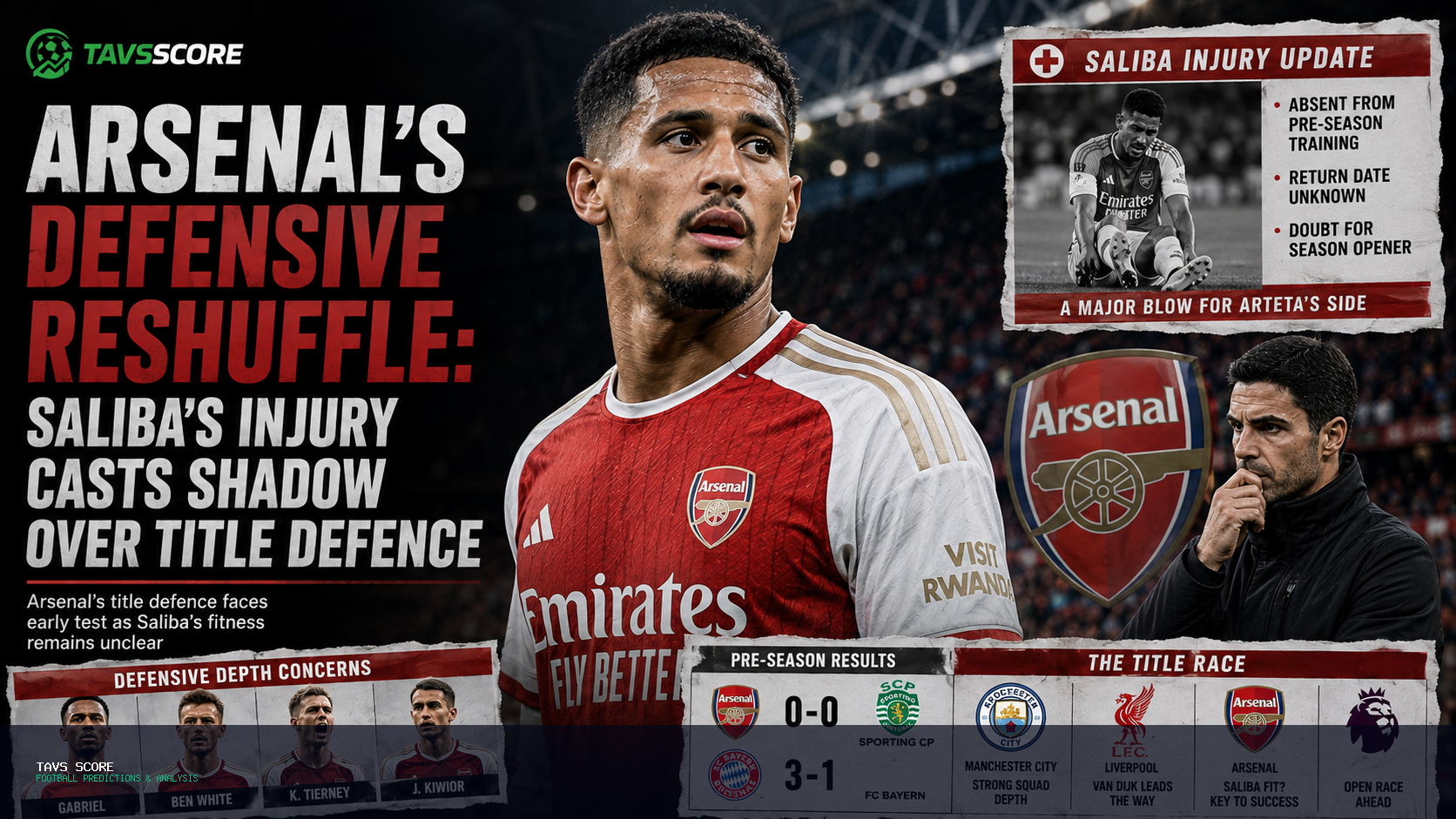
Arsenal’s title defence faces early test as Saliba’s fitness remains unclear
Arsenal’s preparations for the new season have taken an immediate hit with reports that defender William Saliba is facing a potentially lengthy spell on the sidelines. The French international, a cornerstone of Arsenal’s defensive structure under Mikel Arteta, has been absent from pre-season training and remains a doubt for the club’s opening fixtures. While Arsenal have not officially confirmed the severity of Saliba’s injury, the timing could not be worse: the Gunners are set to kick off their Premier League campaign without a clear timeline for his return. With Gabriel Magalhães already established as a first-choice centre-back, Saliba’s absence forces Arteta into a defensive reshuffle that risks disrupting the team’s tactical cohesion just weeks before the league begins.
The impact extends beyond the pitch. Saliba’s injury places additional pressure on Arsenal’s medical team to manage his recovery without rushing him back, while the club’s transfer business this summer—including the high-profile arrival of C. Tzolis from Club Brugge—has not addressed the defensive depth issue. Arsenal’s 0-0 pre-season draw against Sporting CP, played without Saliba, highlighted the fragility of their backline, which struggled to contain Sporting’s attacks despite the absence of key forwards. If Saliba misses significant time, Arsenal may need to revisit their defensive recruitment strategy or rely on untested youngsters like Jorginho or a surprise inclusion from the academy.
For a club that has built its recent success on defensive solidity, Saliba’s potential absence is more than a squad issue—it is a tactical and psychological setback. Arteta’s system demands a composed, ball-playing defender who can step into midfield pressure and initiate attacks. Without Saliba, Arsenal risk reverting to a more reactive style, which could blunt their title ambitions before a ball is kicked in anger.
Arsenal’s summer transfers: depth added, but defensive questions linger
Arsenal’s summer transfer activity has been defined by attacking reinforcements rather than defensive cover. The club’s marquee signing, C. Tzolis from Club Brugge, brings pace and directness to the forward line, but his arrival does little to address the defensive concerns raised by Saliba’s injury. Tzolis, a winger by trade, will compete with Eddie Nketiah, Gabriel Jesus, and Fabio Vieira for minutes, but his defensive work rate remains unproven at Premier League level. The Gunners’ other summer moves—including the free-agent signings of F. Rust and P. Aning—focus on youth development and squad depth, not first-team readiness.
The club’s reluctance to strengthen the defensive ranks this summer may reflect confidence in their existing options. Gabriel Magalhães has been a revelation since his arrival from Lille, forming a formidable partnership with Saliba when fit. However, the Brazilian’s ability to shoulder the defensive burden alone is untested over a full season. Arsenal’s reported interest in young defenders like Delap, who is being monitored by three clubs according to reports, suggests they are aware of the gap—but no concrete moves have materialised. The lack of a proven back-up centre-back leaves Arsenal vulnerable to a defensive crisis if Saliba or Gabriel are unavailable.
Financially, Arsenal’s transfer strategy appears calculated. The club’s reported £1.5bn funding proposal for EFL clubs, agreed in principle with Premier League counterparts, signals a long-term commitment to sustainable spending rather than splash-and-hope transfers. Yet, in the short term, the absence of defensive reinforcements risks undermining that strategy. If Arsenal are to challenge Manchester City and Liverpool for the title, they cannot afford to gamble on their backline’s fitness.
Title race outlook: Arsenal’s defensive frailties could be decisive
Arsenal’s title credentials this season hinge on two variables: Saliba’s fitness and the club’s ability to mitigate defensive absences. The Premier League’s projected title race—framed by reports as the most open in years—offers little consolation if Arsenal’s defensive frailties resurface. Manchester City, despite their own pre-season injury concerns, boast a deeper squad with multiple centre-back options, while Liverpool’s Virgil van Dijk remains a reliable anchor. Arsenal, meanwhile, could be forced into a rotation policy that sacrifices defensive stability for squad rotation, a risky strategy in a league where clean sheets are often decisive.
The club’s recent pre-season performances have done little to dispel concerns. A 3-1 defeat to Bayern München in a friendly, played without Saliba and Gabriel, exposed Arsenal’s defensive vulnerabilities, with Bayern exploiting space behind the full-backs. While pre-season form is not indicative of the season ahead, the pattern is worrying: Arsenal’s backline, even in training matches, has struggled to maintain shape without their star defender. If Saliba misses the first month of the season, Arteta may need to deploy a back three or a more conservative 4-1-4-1 formation to compensate, a tactical shift that could blunt Arsenal’s attacking ambitions.
The financial implications are also worth considering. Arsenal’s reported £1.5bn EFL funding proposal suggests a club prioritising long-term stability over short-term splurges. Yet, the cost of defensive reinforcements—whether through the transfer market or internal development—could prove a necessary investment if Saliba’s absence drags on. The club’s hierarchy may argue that Gabriel and Saliba’s partnership is strong enough to weather the storm, but football is a results-driven business. A slow start, even if temporary, could derail Arsenal’s title challenge before it begins.
Squad depth and player pathways: where Arsenal go from here
Arsenal’s squad depth in defence is now a critical talking point. Beyond Gabriel and Saliba, the club’s options are limited. Jorginho, a defensive midfielder, has occasionally deputised at centre-back in training but lacks the physical profile for a Premier League backline. The club’s reported interest in young defenders like Delap—a reported target of three clubs—highlights their search for long-term solutions. However, Delap’s availability and readiness remain uncertain, and no deal has been confirmed. The club’s reliance on academy products like Ethan Reo-Coker or a surprise inclusion like a recalled Calum Chambers underscores the thinness of their defensive options.
Saliba’s injury also raises questions about Arsenal’s player pathway. The Frenchman, 25, is entering the prime years of his career, and his fitness will be closely monitored. If he misses significant time, Arsenal may need to accelerate the development of younger defenders like Reo-Coker or academy graduate Daniel Ballard. The club’s reported focus on sustainable spending suggests they are unlikely to panic-buy a defender, but the reality of the Premier League may force their hand. A loan move for an experienced centre-back—similar to Arsenal’s past deal for Rob Holding at Newcastle—could be the pragmatic solution, though no such move has been reported.
For Arsenal’s young attacking talents, Saliba’s absence could provide opportunities. Declan Rice, already a key figure in midfield, may need to adopt a more defensive role if Arsenal revert to a back three. Meanwhile, Tzolis’ direct style could thrive in a system that prioritises transitions, but his defensive contributions will be scrutinised. The club’s ability to balance risk and reward in their tactical approach will determine whether Saliba’s injury becomes a footnote or a defining narrative of their season.
What this means for Arsenal’s fans and the wider Premier League
For Arsenal supporters, Saliba’s injury is a reminder of the fragility of success. The club’s rise under Arteta has been built on defensive organisation, and the loss of their most influential defender risks eroding that foundation. Fans will hope for a swift recovery, but the club’s lack of defensive reinforcements suggests they are preparing for the worst. The pressure on Arteta to adapt tactically—without sacrificing the team’s identity—will be immense, and the early weeks of the season could define Arsenal’s campaign.
For the Premier League, Arsenal’s defensive crisis is a microcosm of the league’s evolving dynamics. Reports indicate that the title race could be the most open in years, with multiple clubs—including Liverpool, Manchester City, and now Arsenal—capable of challenging for honours. However, the league’s physical demands mean that defensive frailties are rarely papered over for long. If Arsenal’s backline struggles, it could hand an advantage to rivals who boast greater squad depth. The financial disparities between clubs, highlighted by Arsenal’s reported EFL funding proposal, may also play a role: wealthier clubs like Manchester City can absorb injuries more easily, while Arsenal’s margin for error is slimmer.
The coming weeks will reveal whether Arsenal’s defensive reshuffle is a temporary blip or the beginning of a longer-term challenge. For now, the club’s title ambitions rest on Saliba’s fitness and the tactical ingenuity of Mikel Arteta. If the worst-case scenario materialises, Arsenal may need to look beyond their summer transfers for solutions—whether through the loan market, academy breakthroughs, or an unexpected defensive signing. One thing is certain: the Premier League does not forgive defensive weaknesses, and Arsenal’s early-season fixtures will test their resolve like never before.