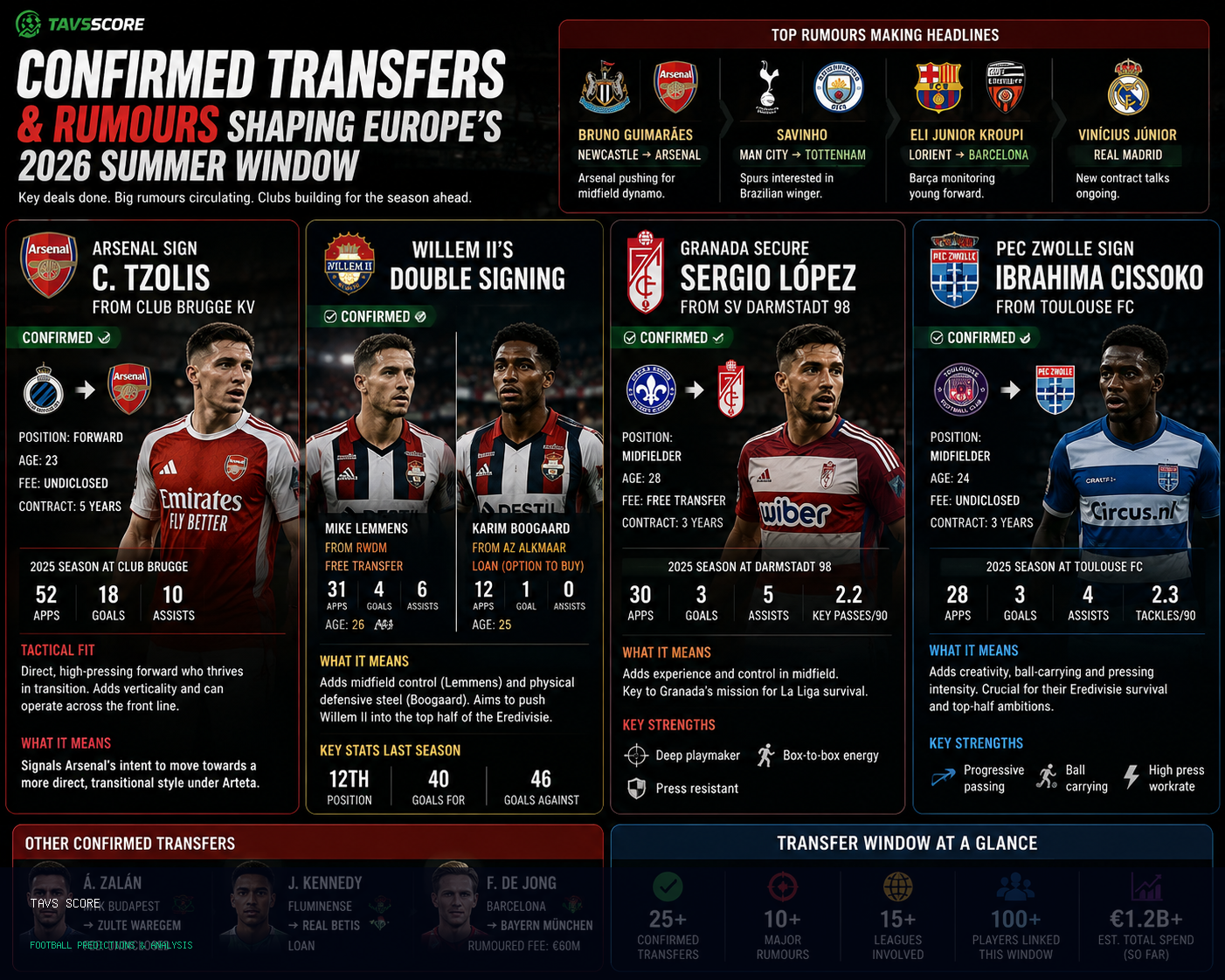
Arsenal’s move for Tzolis signals a clear tactical shift
Arsenal’s completed capture of Christos Tzolis from Club Brugge KV is the first concrete evidence of a summer rebuild under Mikel Arteta that may move away from the club’s traditional 4-3-3 system. The Greek international, 23, arrives with 18 goals and 10 assists in 52 appearances for Brugge last season, numbers that suggest he can operate as a direct, high-pressing forward rather than a traditional winger. This fits a pattern seen in Arteta’s side last term, where Eddie Nketiah often played as a lone striker with wide runners stretching play vertically.
The signing matters because it addresses a positional need without requiring a marquee fee. Tzolis’ profile allows Arsenal to press higher up the pitch, compressing play and forcing turnovers in dangerous areas. His link-up play also provides an alternative to the more static target-man role Bukayo Saka sometimes filled when deployed centrally. While the Gunners have not yet revealed a tactical tweak, the presence of a player who can transition quickly from defence to attack suggests Arteta is prioritising transitional intensity over possession dominance in the early stages of the season.
For Tzolis, the move represents a step up in competition and salary, but it is not without risk. Club Brugge’s recent Champions League performances show they thrive in structured, possession-based systems, whereas Arsenal’s 2025-26 struggles often stemmed from a lack of verticality. If Tzolis is asked to play in a more rigid system, his directness could be neutralised. His first few months in England will reveal whether he can adapt to the Premier League’s physical demands while maintaining his high pressing triggers.
Arsenal’s transfer activity has so far been pragmatic rather than spectacular, with the club avoiding the headline-grabbing moves that defined previous windows. Tzolis’ arrival, alongside other squad additions, suggests a focus on role-specific upgrades rather than positional overhauls. Whether this approach can translate into a title challenge remains to be seen, but the early data points to a squad being built for transitional football rather than sustained possession.
Willem II’s double signing reshapes their Eredivisie ambitions
Willem II’s summer business has been unusually decisive, with two arrivals that could push the Tilburg club toward the top half of the Eredivisie. The free signing of RWDM midfielder Mike Lemmens, 26, provides immediate competition in central midfield, while AZ Alkmaar’s Karim Boogaard arrives on loan with an option to buy. Lemmens’ arrival is particularly notable because he played 31 league games for RWDM last season, contributing four goals and six assists, while Boogaard’s physical presence adds a new dimension to Willem II’s pressing game.
The pair’s arrival matters because Willem II finished 12th in the Eredivisie last season, just five points clear of relegation. Their attack was mid-table, but their midfield often lacked the intensity to win second balls or transition quickly from defence to attack. Lemmens’ profile suggests he can add stability in build-up play, while Boogaard’s loan deal—if activated—would give Willem II a more aggressive defensive structure. The club’s strategy appears to be upgrading the spine of the team to compete with the mid-table sides rather than targeting an immediate push for Europe.
For Boogaard, the loan represents a chance to revive his career after a difficult spell at AZ Alkmaar, where he made just 12 league appearances. The Eredivisie is known for its physicality, and Boogaard’s ability to win aerial duels could be crucial in a league where set-pieces often decide tight games. If Willem II exercise their option to buy, the deal would be a shrewd piece of business: AZ would likely recoup some of their investment, while Willem II would gain a player who fits their pressing system.
The club’s transfer activity also reflects a broader trend in the Eredivisie, where smaller clubs are increasingly targeting free agents and loan players to balance their books. Willem II’s financial constraints mean they cannot compete with Ajax or PSV for marquee signings, so they are instead focusing on role-specific upgrades that can improve their tactical flexibility. Lemmens and Boogaard’s arrivals suggest a clear plan: build a team that can press high, win second balls, and transition quickly, even if it comes at the cost of possession dominance.
Granada’s return to La Liga hinges on López’s leadership
Granada CF’s capture of Sergio López from SV Darmstadt 98 is the first major piece of their La Liga return campaign, and it arrives at a crucial time. López, 28, is a versatile midfielder who can play as a deep-lying playmaker or a box-to-box runner, providing Granada with a player who can dictate tempo in a league known for its high pressing and physicality. Darmstadt’s relegation from the Bundesliga last season means López is available on a free transfer, a rare opportunity for a club with Granada’s financial constraints.
The move matters because Granada’s La Liga survival in 2025-26 was largely built on midfield control, with players like Domingos Quina and Bryan Zaragoza excelling in transitional moments. López’s arrival suggests the club is aiming to improve their build-up play, giving them a player who can progress the ball from deep and link defence to attack. His experience in the 2. Bundesliga—where Darmstadt finished 11th last season—also provides a template for how Granada can compete in a league where possession is often surrendered to higher-pressing sides.
For López, the move represents a chance to prove himself in a top-flight environment after years in Germany’s second tier. His versatility means he can slot into multiple midfield roles, which is crucial for a club like Granada that may need to adapt tactically depending on their opponents. If he can replicate the form he showed in Darmstadt’s promotion-winning campaign, he could become a key figure in their push for mid-table safety.
Granada’s transfer strategy reflects their financial reality: they cannot compete with the big clubs for marquee signings, so they are instead targeting experienced players who can slot into a well-defined system. López’s arrival is part of a broader plan to rebuild the squad with players who understand the demands of La Liga, even if they come at a lower cost. The club’s focus on midfield recruitment suggests they are prioritising control over creativity, a pragmatic approach that could serve them well in a league where defensive organisation is often the difference between survival and relegation.
PEC Zwolle’s Cissoko signing underlines their Eredivisie revival plan
PEC Zwolle’s completed transfer of Ibrahima Cissoko from Toulouse FC is the latest in a series of moves that suggest the club is serious about returning to the Eredivisie’s top half. Cissoko, 24, arrives with 28 league appearances and three goals for Toulouse last season, providing PEC with a midfielder who can add creativity and pressing intensity. His arrival follows the club’s promotion from the Eerste Divisie, where they finished second behind VVV-Venlo, and signals a clear ambition to compete in the top flight.
The signing matters because PEC Zwolle’s promotion was built on a strong defensive structure, but they struggled to create chances against better-organised sides. Cissoko’s profile fits a system that needs more verticality in midfield, with his ability to carry the ball forward and play incisive passes providing a direct alternative to the more cautious approach of their promotion campaign. His experience in Ligue 1 also means he understands the demands of a top-flight league, which could be crucial in helping PEC Zwolle adapt quickly.