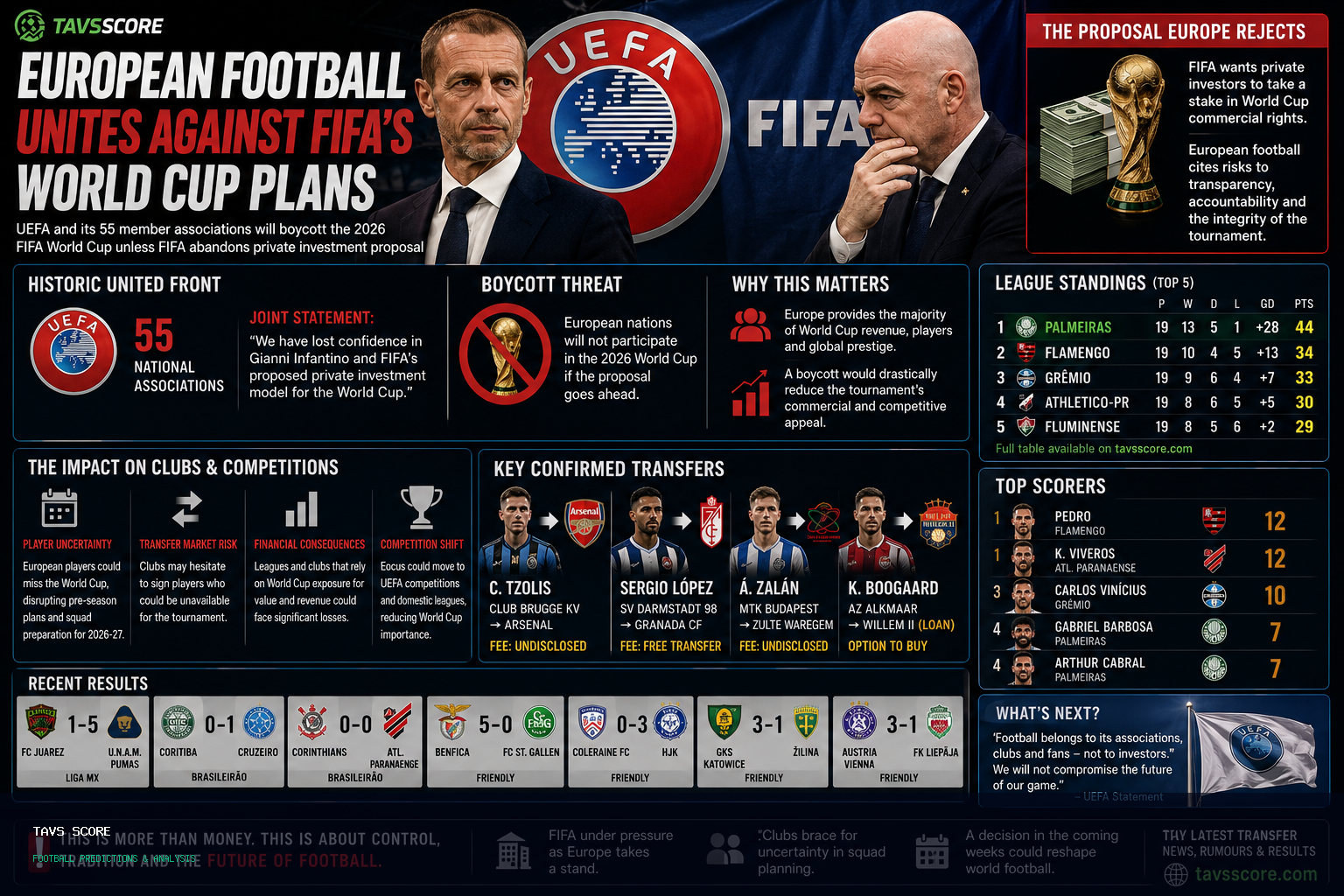
UEFA and its members act together against FIFA’s sell-off plan
European football’s governing bodies have taken an unprecedented step by declaring they will boycott the 2026 FIFA World Cup unless the governing body abandons its latest proposal to introduce a private investment model for the tournament. The announcement, issued jointly by UEFA and its 55 national associations, marks the first time European football has united in open opposition to FIFA’s commercial direction, raising serious questions about the future of the competition and the balance of power in world football.
According to the statement, European football leaders have lost confidence in FIFA President Gianni Infantino over the proposal, which would see private investors take a significant stake in the World Cup’s commercial rights. Reports indicate that the opposition stems from concerns over transparency, accountability, and the potential long-term impact on the integrity of the tournament. The move signals a growing divide between FIFA and the continent that has historically provided the majority of the World Cup’s revenue, players, and prestige.
UEFA’s decision to boycott the World Cup is not just symbolic; it represents a strategic challenge to FIFA’s authority. European clubs and federations generate the bulk of global football revenue, and their withdrawal would significantly diminish the tournament’s appeal, both commercially and competitively. The timing of the announcement—just days before the summer transfer window closes—adds pressure to FIFA to reconsider, as European clubs remain the driving force behind player transfers and club competitions.
Why this matters for clubs and competitions
The potential boycott has immediate implications for clubs across Europe, particularly those with World Cup participants in their squads. Players from European nations would face uncertainty over their participation in the tournament, which could disrupt pre-season preparations and affect squad planning for the 2026-27 season. Clubs may also reconsider their long-term investment in players who are likely to be called up for international duty, especially if the dispute escalates.
For leagues like the Eredivisie, Ligue 1, and the Scottish Premiership—where clubs rely heavily on World Cup exposure for player valuation—this uncertainty could have financial consequences. Scouts and agents may hesitate to push for transfers involving players who could miss the tournament, while clubs may prioritise domestic form over international commitments in squad selection. The briefing’s transfer data, which includes several free-agent signings and loans to lower-league clubs, suggests a market already cautious about long-term planning.
European competitions such as the UEFA Champions League and Europa League could also feel the ripple effects. If FIFA’s proposal proceeds, it may accelerate a shift toward regionalised club football, where European clubs focus on domestic and continental competitions rather than relying on the World Cup for global exposure. This could further entrench the dominance of Europe’s top leagues, while smaller federations may struggle to retain talent and investment.
The commercial and political stakes
The FIFA proposal has exposed deep divisions in football’s governance. Reports indicate that European football bodies view the private investment model as a threat to the sport’s traditional structure, where revenue is shared among member associations rather than concentrated in the hands of a few investors. The briefing’s transfer data—featuring moves like C. Tzolis’ transfer from Club Brugge to Arsenal and E. Demirovic’s free-agent move to Arka Gdynia—hints at a market still adjusting to financial pressures, even as top clubs secure high-profile deals.
FIFA’s attempt to introduce private investment into the World Cup is part of a broader trend of commercialisation in football, but it risks alienating the very stakeholders who have built the tournament’s legacy. The European boycott could force FIFA to revisit its plans, particularly if other confederations follow suit. However, if the dispute persists, it may lead to a fragmented football calendar, with clubs prioritising domestic leagues and continental competitions over the World Cup.
For clubs, the uncertainty could delay long-term planning. The briefing’s data shows a mix of free-agent signings and loans, which may reflect clubs’ caution in committing to expensive transfers amid broader financial instability. If the World Cup boycott proceeds, clubs could face further disruption to their transfer strategies, particularly for players likely to be called up for international duty.
What happens next?
The next few weeks will be critical in determining whether FIFA backs down or doubles down on its proposal. European football’s united front sends a strong message, but FIFA has shown little willingness to reverse course in the past. The briefing’s data—showing transfers across multiple leagues, including Palmeiras leading the standings with 44 points—underscores the global nature of football’s challenges, where financial and governance disputes can have far-reaching consequences.
For clubs, the priority will be damage control. Managers and sporting directors may need to adjust pre-season plans if key players are unavailable for World Cup duty. The briefing’s transfer activity, including loans like Léo Linck’s move from Botafogo to Estrela, suggests clubs are already preparing for uncertainty, whether due to financial constraints or squad instability.
If the boycott proceeds, the 2026 World Cup could become a shadow of its former self, with reduced European participation and diminished commercial appeal. For European football, the move is a bold statement—but one that carries significant risks. The coming weeks will reveal whether FIFA will listen or whether the sport’s governing bodies are prepared to sacrifice the World Cup in the name of preserving football’s traditional values.
The broader implications for football’s future
This dispute is not just about money; it is about control. FIFA’s proposal to involve private investors in the World Cup reflects a shift toward a more corporate model of football, where commercial interests take precedence over the sport’s traditional structures. The European boycott challenges this vision, arguing that the World Cup should remain a tournament for the world’s football associations, not a financial asset to be traded.
The briefing’s data—showing transfers across leagues as diverse as Brazil’s Serie A, the Eredivisie, and Poland’s Ekstraklasa—highlights the interconnectedness of modern football. A boycott of the World Cup would disrupt this ecosystem, affecting everything from player transfers to club finances. For smaller clubs, already operating on tight budgets, the fallout could be severe.
Ultimately, this is a test of football’s governance. If FIFA refuses to back down, European football may be forced to explore alternatives, such as strengthening regional competitions or even creating a rival tournament. The briefing’s transfer data—featuring free-agent signings and loans—suggests clubs are already bracing for a period of instability. The coming weeks will determine whether football’s leaders can find a compromise or whether the sport’s future will be shaped by financial power rather than sporting tradition.